Music Connections

Sharing how music helps families make positive connections.

Mother’s Day Sing-a-long and Traditions

This sweet animated clip features a mother spider and her loving child, who is singing about how his mother loves him just because he is her child.  The words are included, and I know you and your child will enjoy watching and singing along with this one!

You may even enjoy coming up with your own words to the song, pointing out specific things that you love about each of your children, and what they love about you.  No matter what their age is, children thrive on hearing all the different things you love about them.  Adults do too.

Mother’s Day is also a wonderful time to retell the story of your child’s birth, from the moment there was a desire in your heart for a child through to the day they were born.  This tradition will become a beloved bonding experience each year. 

Since I wrote a song for each of my children before they were born, I include that song in their story.  Other parents I know CHOSE a favorite song to represent their love.  To see a list of songs parents have chosen to be a special connection with their child, see my resources blog posting:   Songs for Mothers and Fathers 

I also bring out the artwork that I did while I was pregnant,  (I crafted a little baby and several acessories out of beeswax modeling clay), as well as their artwork from each Mother’s Day.  I keep them all in a treasure box to bring out for special occasions, like this and their birthdays, and even days when I can tell they just need to be reassured of their worth.  Or sometimes, just for myself, when I need to refocus on the love that brought them into the world, instead of the daily frustrations that sometimes block that vision.

On Mother’s Day, and all the days of being a mother, even on the really tough days,  I wish you peace, contentment, and a full heart!  Life just wouldn’t be the same, it wouldn’t be so full of laughter, love, and learning, without our children.  I am so glad to be “MOM”!

Merry Melodies,
Debbie Mondale

May 9, 2008 Posted by Debbie Mondale | Activity ideas, All ages, For Your Enjoyment, Holiday, Rituals | , , , | 1 Comment

Latin flavors of music spice up the world

 Happy Cinco de Mayo!

Each year, I love celebrating the declaration of Independence by Mexico, through the marvalous food, music, and dancing if I can!  During the final classes of Kindermusik for the Young Child 4 (our Graduating class), we are studying Latin Music, instruments, stories, and more. 

For your enjoyment, listen to the wonderful story of Don Gato (a cat in love), explore the child friendly website Kaboose, listen and relax to a video of a local flemenco guitarist, and make plans to attend the annual Latin Fest at Cypress Gardens.

In Kindermusik class, we learn the story of Don Gato, and use instruments to add our own sound effects.  Surprisingly enough, I found an animated version on You Tube.  Enjoy!


Kaboose is an online site that offers children cool resources to learn more about the history of this celebration, as well as crafts, recipies, games, and printables for coloring, such as the pretty little girl above.  Check it out: http://holidays.kaboose.com/cinco-de-mayo/ 

I wanted to share some wonderful flamenco music by our own local artist, AND my son’s very favorite guitar teacher,  Nathan Herrera.  Check out his website for more information about his background and performances:  http://nathanherrera.com/  .  Or listen to more of his music at http://www.myspace.com/nathanherrera .  He is also the owner of Blue Noche’, one of the newest music studios in town, focusing on guitar, piano, voice, and more.  James even studied French Horn with an educator there.


There is also a wonderful Latin Celebration going on ALL week at Cypress Gardens, lots of food, music, and dancing steeped in cultural traditions and celebrations.  Check out the info at www.cypressgardens.com .  This is a great way to fully immerse yourselves into the Latin culture, a spicy one, full of life! 

“Mixing Latin music with spicy flavor, guests will not want to miss the Cypress Gardens Latin Festival. The excitement starts Monday, May 5 and continues through Sunday, May 11. Those who love to indulge in Latin food will have the opportunity to try cuisine from different Latin cultures. Each day, park guests can enjoy the festive music of a strolling mariachi band or the sounds of a classical Spanish guitarist. Appearing on stage for the festivities include Carlos Oliva (Friday, May 10 and Saturday, May 11 at 3 p.m.), Ismael Miranda (Friday, May 10 at 7:30 p.m.) and Tito Nieves (Saturday, May 11 at 7:30 p.m.). A special seven-day pass can be purchased for $49.95 so that guests can enjoy each day of the event.”  If you just want to attend an evening concert, it is just $15.

May 5, 2008 Posted by Debbie Mondale | 5 - 7 years, All ages, For Your Enjoyment, Young Child: Ages 5-7 | , , , , , | No Comments

Silly Symphonies - Great interplay between music & movement

Although I am including “Merbabies” for my Kindermusik Creatures at the Ocean semester, this is a great way to recognize the wonderful interplay between music and animated movement.  Disney, of course, has a wonderful way of developing animation to bring out the best in the music, and developing music to bring out the best in a story.

While watching this video with your child (2 (sometimes) or older), use the pause button and stop the video every now and then to talk about the music, the instruments, the sound effects, and how it relates to what is going on in the story.  Ask open ended questions, and have them respond to the music when they hear particular things.   See the ideas listed below:

  • How does the music sound like the waves you see? 
  • Tell me to pause when hear a sound effect that is not made by an instrument?  (use this repeatedly)
  • How does the music sound different when you see the bubbles, compared to when you see the waves?  (This is a staccato / legato concept.)
  • How does the music sound when the babies are splashing and when they are laughing?
  • Tell me when the music sounds happy, or sad.

These are just examples of the types of ways parents and children can interact with this type of video to help children become more aware of how music enhances actions and emotions.

April 21, 2008 Posted by Debbie Mondale | Kindermusik International | | No Comments

Musical Flowers and Trees

 Again, this is for my Kindermusik Village families taking the Drewdrops Semester.

This video is part of Disney’s Silly Symphonies.  It is the first film that was released in full color.  It premiers on July 30, 1932.

Of course, classical music is a staple of the earlier Disney films.  Be aware that the scene includes a fire that threatens the wildlife of the forest and may be scary for some children, but the birds come to the rescue and it has a happy ending with flowers playing the Wedding March.

This next video features babies playing around with nature, including using flowers in an amazing myriad of ways.  It could be more for the grownups than the babies, only because the length is more than 8 minutes.

April 20, 2008 Posted by Debbie Mondale | All ages, For Your Enjoyment, Kindermusik International, Village - babies | , , , | 1 Comment

Dewdrops

This video is for my Kindermusik Village families currently enjoying the Dewdrops semester.

In our children’s book, each page has a dewdrop on the flower for the child to find.  This video extends this activity.  This music video is packed full of the most beautiful pictures of dewdrops that I have ever seen.  The music is beautiful and full of sounds, harmonies, and rhythms that will be an enriching sound experience as well.

The video does not implicate the musical artist, or the photographer, but was posted by “winterwood”.   More videos can be found from them there.


April 20, 2008 Posted by Debbie Mondale | 0 to 18 m., Activity ideas, For Your Enjoyment, Kindermusik International, Village - babies | , , | 1 Comment

African Talking Drum - Music that really talks

In our Kindermusik for the Young Child class is currently studying African Cultural Music.  The students got to explore making the changing sounds that my talking drum makes.  I can demonstrate a few rhythms and how the drum changes pitch as the strings are squeezed, but I am no master. 

Fortunately, these YouTube videos allow us to hear from a true master of the Talking Drum.  Rasaki Aladokun of Sonic Soul demonstrates his talent, and answers questions about the instrument during his Berlin Concert on July 20, 2000.  There are two videos in the series:

Rasaki introduces himself and the instrument, and demonstrates what is played at a wedding.  I love the way he not only demonstrates the music, but also what the drum is saying - in both African and English.


Rasaki introduces what may be played at a funeral, and when a King comes to visit.  He also talks about learning the skill from his father, and how his skills developed over time.  Watch for his amazing performance at the end.

I hope you enjoyed this excursion into the world of JUJU music - the traditional music of Africa.  Look around your community to determine if you have a Drum Circle available.  If so, give your family a wonderful music experience - take a drum (even a homemade one) or another percussion instrument.  Listen for awhile, then get involved.  You will hear the drums talking to you. 

Not only is it a rich musical experience, research has shown the participating in drum circles is Excellent at reducing the level of STRESS in the body.  I need that!   How about you?


April 20, 2008 Posted by Debbie Mondale | 5 - 7 years, Activity ideas, For Your Enjoyment, Music Concepts, Young Child: Ages 5-7 | , , , | No Comments

Timbre / SOUND Experiences for young children

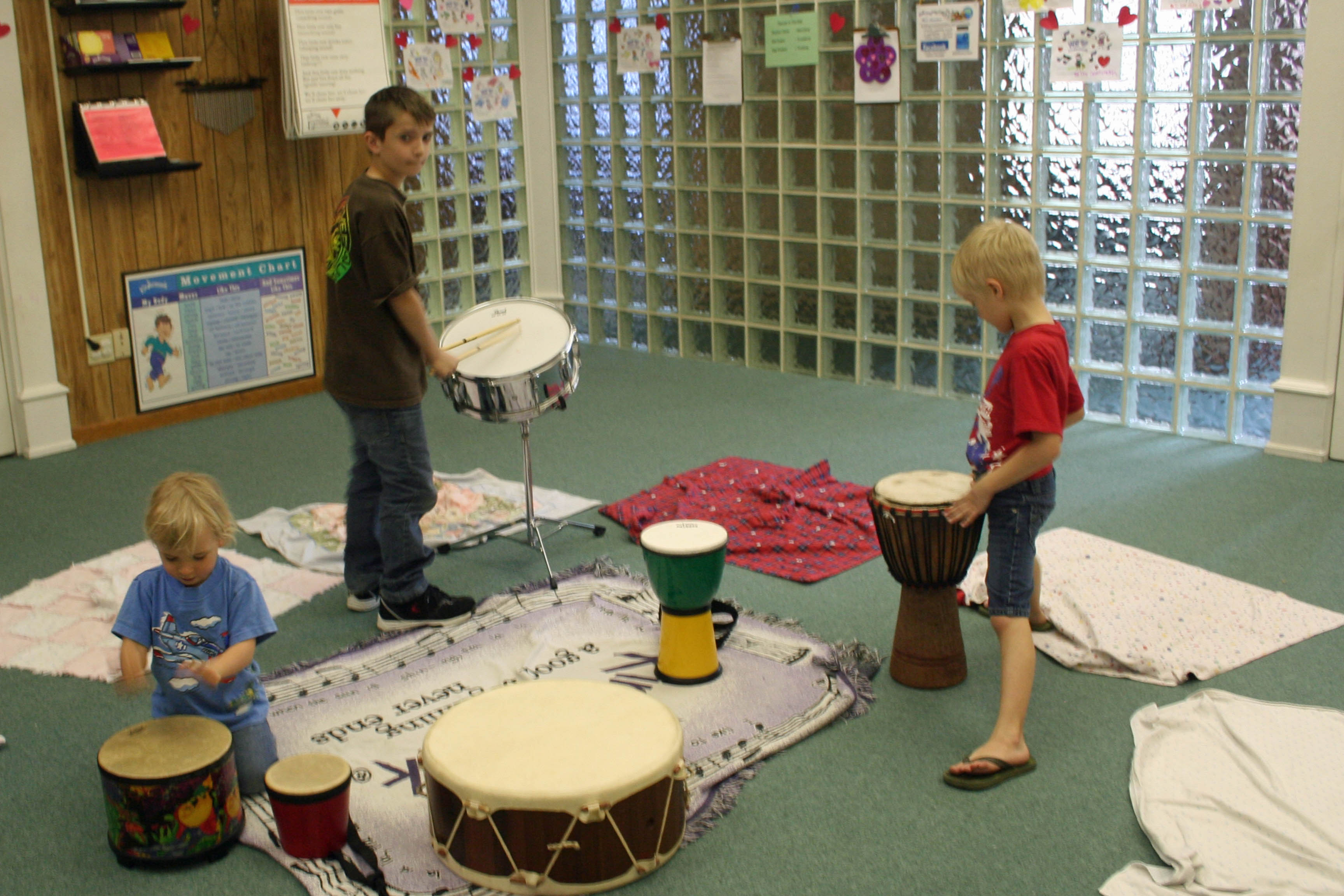
QuinnTimbre (pronounced “tam-ber”) is the distinctive quality of a sound.  During the last few weeks in all the Kindermusik classes, we have experienced many different timbres.  We’ve listened to the sounds of different types of bells, paper bags, a variety of wooden instruments, multitudes of drums (played with the hand to get a better variety of sounds), and much more.  The Young Child class has been using different timbres to represent the sounds of animals during a story song. 

The little ones in our class are developing their own “vocabulary” of timbres.  Just as we recognize the importance of developing a large spoken vocabulary, it is important for us to recognize the importance of developing a similar vocabulary for sounds.  This will help children tune in to subtle distinctions in both music and speech.   

.

Why build a vocabulary of sounds?

  1. Improves interest and ability to hear, distinguish, and recognize sounds, even when the sound maker is not visible.  (Like knowing Mommy’s voice.)
  2. Helps them understand the relationship between the feel and look of an object to the sound it makes.  Bigger things make deeper sounds, smaller things make higher sounds.
  3. Allows them to recognize that even though something may look the same, it may sound different (if different objects are inside it).  Or that things that look different may sound very much the same.  It builds generalization skills.
  4. Research shows that as the variety of sounds in an environment increases, the more the child is interested in making new sounds themselves, allowing them to explore more fully all the sounds they can make.  This in turn has a huge effect on their ability to articulate words when it is time.
  5. old ladyThe neural connections they are building with these basic sounds are the foundation of knowledge, on which they can expand as they develop.  Recognition of a metal sound, leads to recognition of a horn sound, and on to a saxophone sound, and on to a tenor saxophone sound, and on to the specific style a particular artist on the saxophone.
  6. And finally, it leads to a lifetime of enjoyment in making music.  This lady seems to continue to enjoy even in her later years!

 How can I help my baby learn this?   Provide a basket in a popular play location that will hold 2 – 4 objects that make a variety of sounds.  If possible, have some objects that look the same but sound different, such as similar containers with different materials inside.  Or similar objects (wood) that have subtly different sounds.  Keep the same objects in the basket until the child’s interest in what’s in the basket just starts to lessen, then switch them out for totally different objects. (don’t wait until they’re bored, but don’t switch it when they are still fascinated by them).  For the younger babies, keep a few sound makers next to the changing table, especially those that can be worn on their hands, such as “mittens” or “bracelets”, or on a “mobile” they can tap. 

To be able to gain the maximum benefit from this play, the baby should be able to explore ALL the different sounds an object makes (often with your help).  Equally important is exploring the object through their other senses:  What does it look like?  What does it feel like?  What is the texture?  What does it taste like?  Is it heavy or light?  Which parts move?  What movement makes the sound?    Of course they are not asking these questions, but their explorations answer them.  This “learning” is enhanced greatly if an important partner talks about all these things while the baby is exploring.

How can I help my OLDER CHILD learn this?

Children 1 - 2 really enjoy exploring the sounds in a kitchen.  Clean your floor, then partner with your child to pull out items from the cupboard, plastic, metal, etc.  (glass, only when supervised with a parent to ensure safety.), as well as a variety of mallets from kitchen drawers, wooden, metal, etc.  Cutting boards make great sounds. 

picnic baskets

I like to keep a picnic basket full of kitchen sounds so that I don’t have to continue to clean each item after they play with it on the kitchen floor.

Children 2 and older love to MAKE their own instruments.  Are they most interested in making something they can TAP, something they can SHAKE, or something they can RUB.  THEN MAKE TWO - help them find a way to make two of the same type of instrument, but that makes different sounds.

All ages of children love to explore the different sounds that their mouth and voice can make, as well as how they can use their body as a sound making device.  Explore the different sounds you can make in these ways.  Make it a copycat game:  one person makes a set of sounds with their body or mouth, and the other person has to copy what the first person did.  Take turns.  OR hide behind some barrier, and allow the other person to guess how that sound was made.  This is also a wonderful way to improve their listening skills.

There are several previous blog postings that include ideas for your family to explore timbre

Refer to homemade instrument blog postings:

What part does Kindermusik play in this development?  

Kindermusik class is a perfect venue for offering your child the opportunity to experience a wide variety of sounds–drums, egg shakers, baby bells, woodblocks, singing, speaking, plus the host of wonderful and diverse sounds on the recordings!  Kindermusik is the best choice you can make for your child, again and again!                    

April 2, 2008 Posted by Debbie Mondale | Activity ideas, All ages, Music Concepts, Teaching techniques, Vocal Play | , , , | No Comments

Easter Eggs - before, during, and after Easter

Happy Easter

Angel - hornMy best wishes are for you

to enjoy your Easter Celebrations

with your family,  with the angels,

and with eggs full of the joys in life.

.

Angel -ViolinWe celebrate this rebirth with the angels

just as we do the original birth of Christ

Angel - harpWith music and a joyful heart

For all he has done for us.

.

Angel - fluteThere are many ways folks celebrate Easter. 

One of my favorite is watching the joy of discovery

of a child as they seek to find what is filling the

empty space of a freshly found Easter egg.

Personally, there are very few sugary treats found inside the eggs I fill.  I much prefer to fill them with things that will make an impression, for the hunt, for Easter, and long after the festivities over.  A few of my favorites:

Easter Hunt - Objects that can be included in some sort of craft.  Fill the eggs and number from 1 - 8 (or however many eggs need to be filled for the craft).  Children must continue to look for eggs until they have one of each number.  So this works well for one child, or many.  Craft projects may include: 

  • beads and string for jewelry (foam beads or smaller beads…)
  • different colors of playdough or clay
  • foam pieces to make a picture, etc.

Easter Morning - Have large plastic (washed) eggs filled with breakfast items;  small muffins, dry cereal, small fruits like grapes, cherries, or strawberries.  Hide them, along with colorful boiled eggs, for the children to find on Easter morning.

Easter Afternoon -  Use the instructions for Resurrection Eggs, which help solidify some of the facts of the story of why we really celebrate Easter.  Please follow the link, as they explain it much better than I.

Angel - drumAfter Easter - Make TIMBRE EGGS.             This just means filling the plastic eggs with various objects to make different sounds.  I prefer to use colorful electrical tape to keep the eggs closed.  For younger children, use edible items (just in case they come open). For fillings, you may use:

Small items for a light sound - rice, small cereal, small beads, paper clips, Goldfish snacks

Medium item for great shaker sound - unpopped popcorn, beans, coffee beans, jelly beans, plastic beads, jingle bells

Large items for a clunky sound - pecan, or small nut, wooded spool, marble

For non-food items try to include at least one egg filled with each of the following materials; metal, wood, plastic, glass (like a marble) and any other that you think will make a different sound. 

Babies/Toddlers:  Just have these available to explore with your child frequently.  Listening to these varieties of sound (also called TIMBRE) is excellent for building neural pathways for these sounds - providing them a foundation for understanding the sounds in their environment.  Young children  also like open-able eggs filled with different textures to explore. 

Toddler/Preschoolers:  Make two of each kind.  Let the child listen to the sounds and match the ones that are the same.   Younger children should only have a few choices (like 3 sets), whereas preschoolers can handle more sets.  These children are not quite ready to identify the object, but can match them.  Make sure they have a chance to use their new instruments to make a parade around the house or yard sing their favorite songs, or marching to the sound of music.  Have fun!

Older Children: Make a list of the things you have used.  After all have been made, have the children listen to the sound and determine what objects were put in that egg.  This is EXCELLENT for LISTENING DISCRIMINATION. 

This is a great project to do WITH the children.  (I don’t suggest including these in the hunt, because they will do whatever they have to to open the egg.)  If you do this WITH them, they see what goes IN the egg already, and can focus their attention on the SOUND instead.

GranGran GraphicsAngel pictures and holiday greeting clip art by GranGran

March 23, 2008 Posted by Debbie Mondale | Activity ideas, All ages, Holiday | , , , | 1 Comment

Kindermusik Family Time in the Summer

Summer Kindermusik Adventures feature

Kindermusik Family Time

  • Families enroll for a full semester:  60 min. class each month for 5 weeks. 

  • For families with one or more children, from infants up to 7 or more. 

    • Every FridayJuly 11 - Aug. 8  Times10:00, 11:15 am, 3:00, 4:15 pm
    • SATURDAY Option:  At least two different classes will be presented every 3rd Saturday in June, July, & August - this will accommodate attending at alternative times - if a family knows they will be out of town for a particular class.  Contact Debbie for the Saturday Schedule.

    The Kindermusik Family Time is a fabulous program developed by Kindermusik encouraging full families and children of all ages (even grandparents) to fully participate in the fun and learning that music and movement can bring! 


“Moving & Grooving” Semester


“Moving & Grooving” is a “romping, rolling, stretching good time for the whole family. This ten-lesson unit of Family Time will explore lots of different ways to move—high and low, fast and slow, zigzag, curvy, and more. Family members will chug around the classroom like trains, clip-clop like horses, and roll over like puppy dogs. They’ll hear a story about playing tag together in Can You Catch Me?, and read about a jungle hokey-pokey in Put Your Left Paw In.   Show your best groovin’ moves—it’s time for Movin’ & Groovin’.” 

As with all Family Time classes, there is a lot of singing, dancing, exploring instruments, and playing with fun props like scarves, balls, parachutes, and lots more.  Come and enjoy the musical fun together with your children.  It will build beautiful memories within you and your children, and you will be amazed at how musical your lives will become.

M-G materialsThe fabulous home kit includes:

  • 2 CDs featuring high quality music - all the songs we cover in class
  • Family Home Guide - Words to the songs, as well as loads of fun ideas for expanding on the ideas presented in class
  • Two children’s Literature books (discussed above)
  • Two instruments - Wooden Den-den Shakers
  • Two puppets - featuring Rascal the Monkey from the Jelly Bean Band
  • A Jelly Bean Band Card Game - focusing on ways of moving
  • A plastic zip top bag to carry it all in!

PLEASE register in advance, as space is limited.

Contact Debbie: 816-8835        musiconnx@att.net 

Or register online !

March 17, 2008 Posted by Debbie Mondale | All ages, Family Time, Lakeland, Summer Semester | , , , , , | No Comments

Children, Children, build me a boat

In the Imagine That! Toys I Make, Trips I Take semester, we have been working together to build toys, and BE toys for an imaginary toyshop - singing our way through the whole process.  The last two weeks, we have been building a boat, and taking imaginary trips in it, reading stories about it, and watching the stars in it.  Last week, the children were challenged to build their own boat, any way they want.  Enjoy watching the creative ideas they developed!

 
| View Show | Create Your Own

Each of them are so proud of their creation!  And it was amazing how many different styles of boat, out of such various materials, with such unique features came into the Kindermusik class this week! 

I do have to comment - allowing the child to lead the process is sometimes very difficult for parents.  I KNOW how important and beneficial it is, but I’m telling you, it took FOUR days to let Cora develop her own plan and carry it out, and that is HARD for me as a parent to be patient and not just take over and lead the process.  When she got stuck, I would suggest option after option until I could see the spark in her eyes (I wouldn’t accept a lackidasical ”Well, alright”)  Then we would work through how to make it happen.  She had to be excited about it, and know that it was her chosen plan in order to get her to be motivated enough to follow through on it.  But in the end, she was very happy with her house boat, and the other children seem to enjoy it as well.

As a matter of fact, there was something special about each child’s boat that made it interesting to the other children.  One had characters in it to play with. One would actually float.  One was a Harry Ferry Boat, complete with trucks.  Several boats were able to get into, but each had a different way of powering their ride - a motor, oars, and one was even powered by a magic fairy wand. 

I could go on and on, but the main point is, that it is extremely worthwhile to step into the world of your child’s imagination, and encourage and assist them to help some of their creative ideas come to life. 

Children, Children, build me a boat, so on the ocean WE may float.  Enjoy!

March 17, 2008 Posted by Debbie Mondale | 3 - 5 years, 5 - 7 years, Activity ideas, Class Reflections, Imagine That - preschoolers | , , , , | 2 Comments